Freeze the claim before searching
Copy the exact statement and separate it into testable parts:
- legal entity and any subsidiary or partner;
- customer, agency, investor, or regulator;
- action, such as selected, awarded, obligated, approved, certified, patented,
tested, or delivered;
- dollar amount and whether it is ceiling, potential value, obligation, revenue,
or funding raised;
- aircraft, service, program, and geography;
- announcement date, effective date, performance period, and record date.
“Selected for a program” is not the same as “received a contract.” “Up to
$100 million” is not the same as $100 million obligated.
Match each claim to the record that can prove it
Scroll horizontally to compare all columns.
No single database covers every UAS business. Private financing, state and local
procurement, classified work, subcontracting, other transaction agreements,
foreign approvals, and confidential orders may require different records or may
not be public.
Use stable identifiers, not names alone
Names change and collide. Find the identifier attached to the record: SEC
Central Index Key, solicitation or notice ID, procurement instrument identifier,
Unique Entity Identifier, federal award ID, FAA docket or exemption number, FCC
ID, patent publication or grant number, and application number.
The SEC filing search supports
company-name, ticker, and CIK research as well as full-text searching. Confirm
the filer and read the filed HTML or text plus relevant exhibits. A current
report can disclose a material agreement, but the exhibit and later periodic
filings may contain scope, conditions, amendments, risk language, or financial
treatment missing from a news release.
Entity resolution is equally important in procurement. Search parent,
subsidiary, former name, team members, and the exact identifier printed in the
announcement. Do not assign a partner's award to every member of a team unless
the record supports that allocation.
Distinguish procurement stages and dollars
SAM.gov Contract Opportunities includes notice
types such as presolicitation, solicitation, award, and sole-source notices. A
request for information or sources-sought notice can show agency interest. It
does not establish that a procurement will occur or that a respondent will win
it. Amendments can change scope, dates, quantities, and eligibility, so preserve
the notice history.
When the announcement concerns a U.S. defense procurement, Military Contractor's
guide to
finding and reviewing defense opportunities on SAM.gov
explains how to locate the notice, distinguish its requested action, and retain
its attachments and amendments. Those steps help establish which procurement
stage the announcement actually describes.
For reported spending, the
USAspending About the Data guide
distinguishes prime awards from subawards and individual transactions from award
summaries. Review the base action and modifications. State whether a number
represents a potential ceiling, a current obligation, an outlay, or another
field. Those amounts answer different questions. The guide also notes that
award-level outlay reporting became mandatory beginning in fiscal year 2022, so
earlier award-level outlay data may be incomplete.
A defensible sentence identifies the named recipient, the amount obligated, and
the date of the latest transaction shown in the agency record. It should not say
the full contract ceiling was received unless the transactions show that result.
Read approvals with their conditions
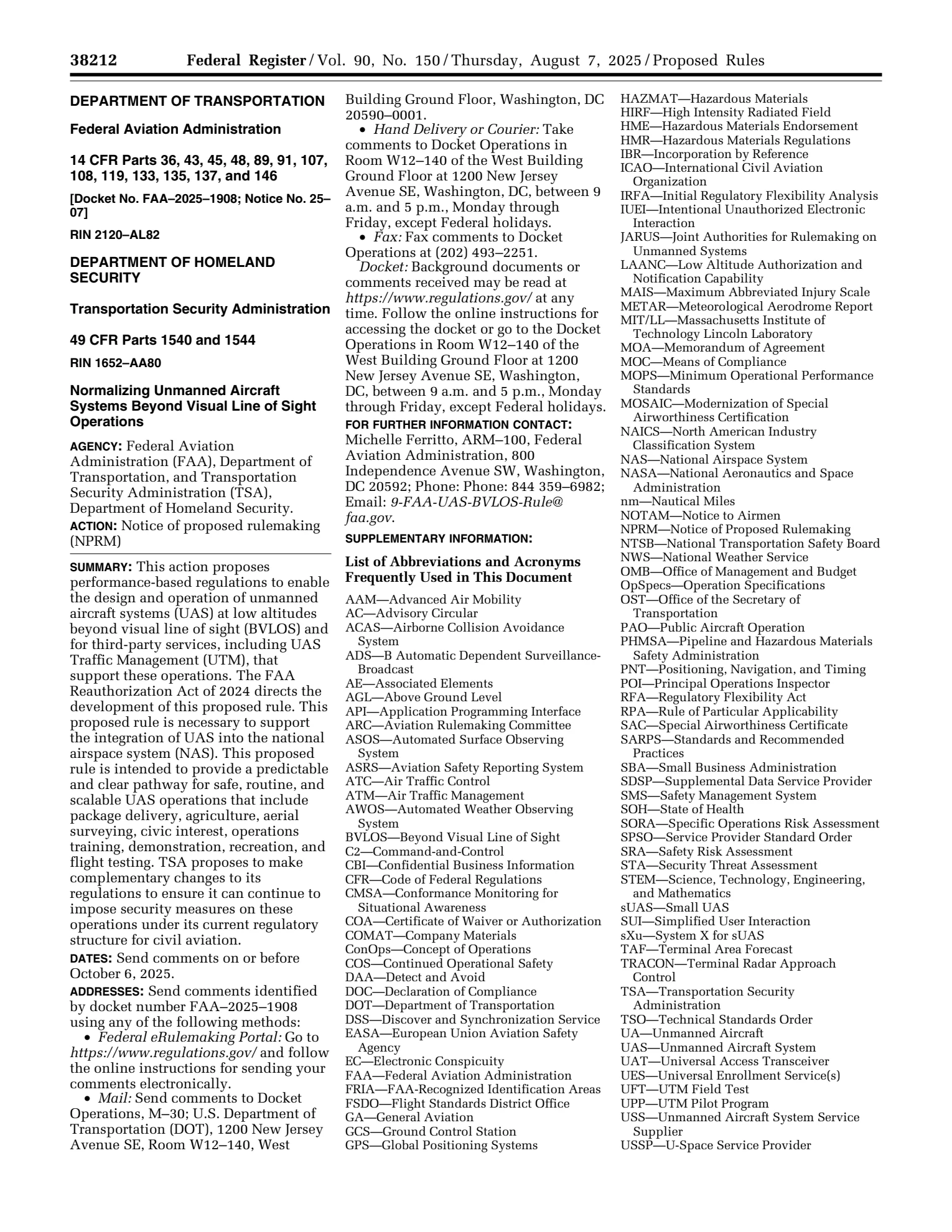
FAA records are scoped legal instruments. The FAA's
Section 44807 page
explains the petition process and points to public dockets. A grant may identify
the petitioner, aircraft, requested relief, conditions and limitations, dates,
and related operational steps. A petition documents a request. Only the FAA's
issued exemption record establishes the relief granted under that path, and the
exemption's conditions and limitations control. Report those elements.
Do not compress an exemption into an unlimited endorsement of the company or
platform. When an announcement groups multiple integration claims together, use
the
Remote ID, DAA, and UTM comparison
to keep identity, tactical avoidance, and strategic coordination separate.
The FAA's current
Section 927 waiver process
is an additional pathway for eligible UAS operations, not a replacement for the
traditional exemption process. The FAA applies the same safety standard to both
paths, while Section 927 does not require the public-interest showing used for
an exemption. Part 107 waivers, certificates, certificates of waiver or
authorization, and airspace authorizations likewise have different scope and
records. Search the pathway actually named in the claim and report only the
authority that record grants.
The
FCC equipment authorization procedures
and
47 CFR Part 2
distinguish Certification from a Supplier's Declaration of Conformity. Certified
equipment has a Commission-issued grant tied to an FCC ID. Equipment authorized
under the declaration procedure does not have that grant or identifier. First
determine which procedure applies. For certified equipment, check the FCC ID,
grantee, grant date, equipment class, frequency information, and exhibits. The
record does not establish that an entire UAS is flightworthy, secure, compatible
with every installation, or authorized for every use.
Treat patents as documents, not product evidence
The
USPTO Patent Public Search
covers U.S. patents and published applications. Confirm whether the cited number
is an application publication or a granted patent, identify the named applicant,
assignee, and inventors, and read the claims rather than relying on the
abstract.
Use the
USPTO Assignment Center to
search recorded patent-interest assignments. Under
37 CFR 3.54,
recording a document is not a USPTO determination of its validity or legal
effect. A recorded assignment is therefore evidence of recordation, not agency
validation of title or the underlying transaction.
A patent grant establishes that claims were granted in that jurisdiction. It
does not prove commercial availability, production readiness, regulatory
approval, performance, freedom to operate, ownership after unrecorded
transactions, or use in a particular product. Some pending applications are not
public, so failure to find a published record is not proof that no application
exists.
Keep a claim-to-record ledger
For every material statement, record:
- exact claim text;
- source announcement and publication time;
- normalized entities and identifiers;
- primary record URL or docket path;
- record type, date, and status;
- what the record proves;
- what remains attributed, ambiguous, or unavailable;
- later amendments or refresh date.
Save enough context for another editor to reproduce the search. Where records
conflict, describe the conflict and prefer the source with authority over that
fact. A regulator controls the content of its approval; an agency record
controls the reported award action; a company filing controls what the filer
formally disclosed, but not whether every prediction came true.
Absence requires restraint. Databases can lag, entity names can differ, records
can be amended, and some transactions are not public. Write “No matching public
record was located in the databases checked as of the stated date,” not “The
claim is false,” unless affirmative evidence supports that conclusion.